How to Break Up with Your Friends - Finding Meaning, Connection, and Boundaries in Modern Friendships: Book Reviw
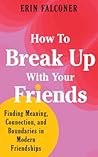
How to Break Up with Your Friends - Finding Meaning, Connection, and Boundaries
in Modern Friendships
Erin Falconer
3.50 stars
This book offered many good points on the topic of friendship. Such as knowing who to keep in your life and how to have better relationships with them, and also that you don't 'owe the rest of your life' to something that isn't working. Falconer gives a host of references to other writers on making and maintaining relationships, however I felt something lacking in spite of the constant use of the word 'authentic'.
As someone much older (judging from the bio photo), I went cold at what I would call calculation in the finding of these 'friends'.
In my younger days, you might meet someone you clicked with through your children's school/sport team or the like, you met them again and you talked again. Rarely did they become 'friends', they were friendly acquaintances. We did not look for 'someone further down the road to where we wanted to go' whether it was in parenting or starting a business, allowed them to download their knowledge to you, and hence considered them your 'friend'. This type of interaction sounded too manipulative for me.
These are the people who arrive when you need them, and don’t necessarily need to be friends. Although some might stay, they should be there for who they are, what they value, not some passing source of information. They should also be there for what you can give to them, that’s what a friendship is to me.
I agree with the idea that you need to know who you are (and what you need) to be a good friend, that friendships take consistency, vulnerability, trust and balance. These are the hallmarks of a long-term friendship and far more than the self-serving attitude that I couldn’t shake through on the pages of this book.
Friendship, a good friendship can last for decades and is not just a reason to fill the void of loneliness or need. What about acceptance of each other's frailties (a friend who is always late) and share with grace that you are not perfect either and probably can even be annoying at times.
Please, Ms. Falconer, write this book again in another two decades and let us know if your views have changed.
Glad I got this one at the library.
I much prefer the way Joshua Becker describes relationships.
For my next read, please visit again.


Comments
Post a Comment